The very least that we can all do is to remind students (and our colleagues!) that they must wear their lanyard and their student card/name badge at all times.
# Lanyards The ANGLO lanyard and attached name badge must be worn by all ANGLO staff, students and group leaders at all times. This is the first way in which we can identify people in our organisation (and therefore, people from outside our organisation who do not have one). Students carry a student card with their name, group leader's name and other information on their lanyard. Group leaders carry a name badge on their lanyard. Staff carry a name badge with a photo and their job role on their lanyard. This includes Head Office staff. Visitors to ANGLO centres must be issued with a lanyard and a visitor badge that must be dutifully returned at the end of their visit. #### Distribution Lanyards and name badges will be issued at any in-person training event or on arrival at centre. # Emergency Reaction Plans It is essential for all ANGLO staff to be familiar with the Emergency Reaction Plans that detail what to do in the event of: - a suspected terrorist/threatening incident - a fire (onsite and offsite) - hearing a fire alarm (onsite and offsite) - an accident or medical emergency (onsite and offsite) - losing a student on public transport - missing students during head counts on excursion These guides can be found on the [Staff Hub](https://staff.anglo.uk.com/safety) and in the Course Office and Teaching Office at centre. It is also essential to familiarise yourself with the simplified student version of the Emergency Reaction Plans which follow the idea of **Run, Hide & Tell**. These posters can be found on the [Staff Hub](https://staff.anglo.uk.com/safety), on Student Hubs and on the noticeboard and in accommodation buildings at centre. [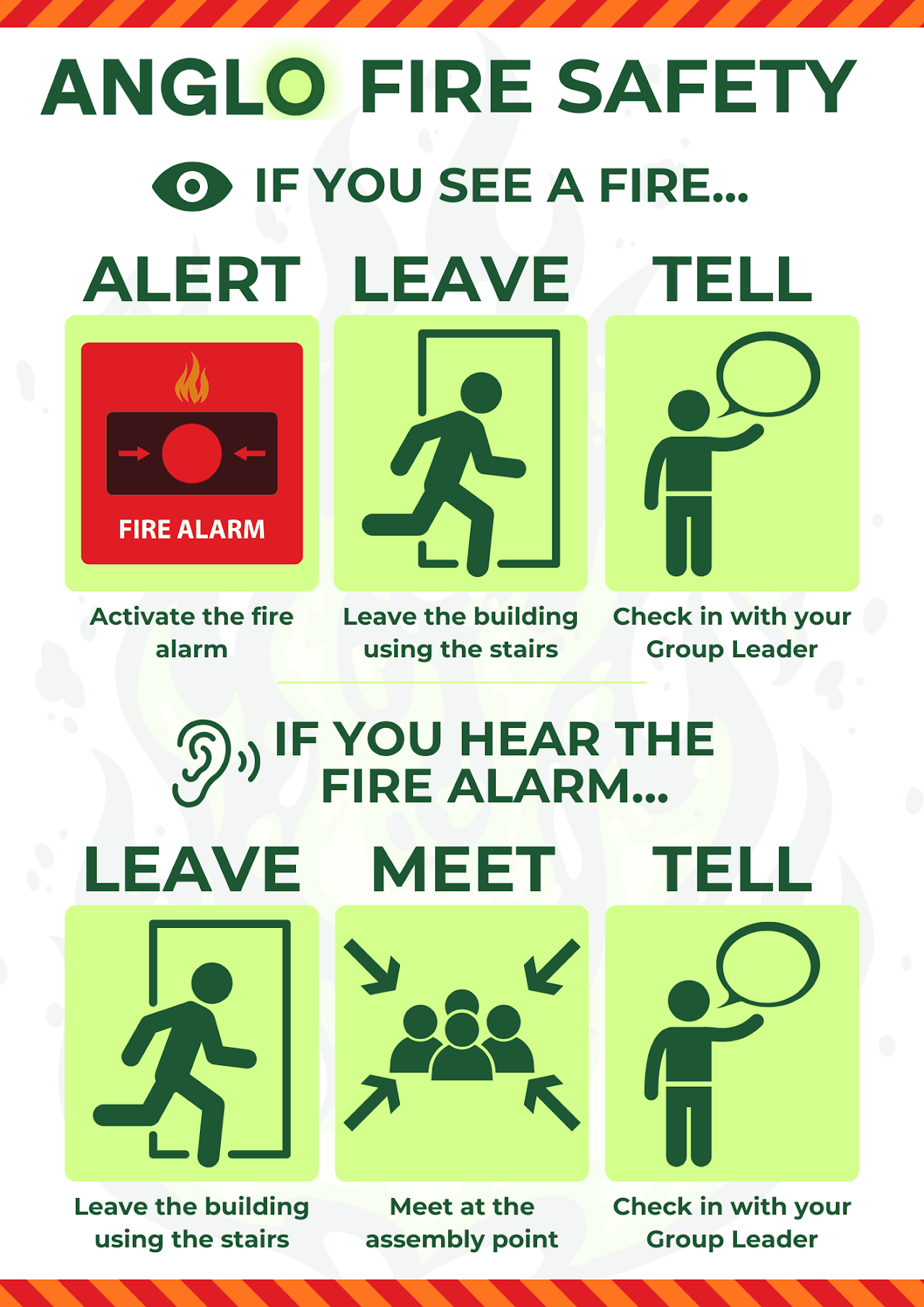](https://docs.anglo.uk.com/uploads/images/gallery/2025-12/kHg7TTiRG5NZwCdx-anglo-fire-safety.png)[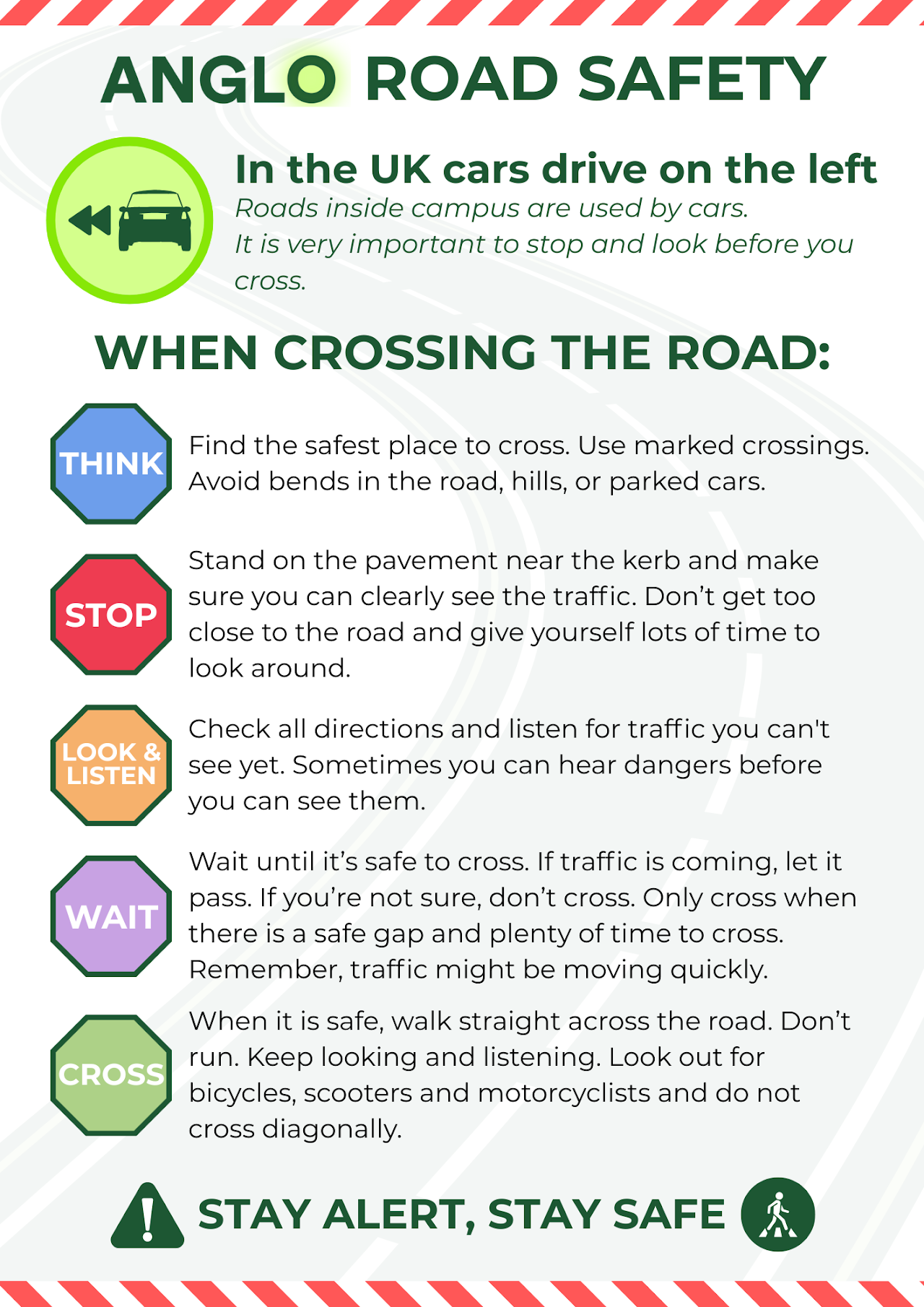](https://docs.anglo.uk.com/uploads/images/gallery/2025-12/FVfJzVSPMKbU5CcT-anglo-road-safety.png)[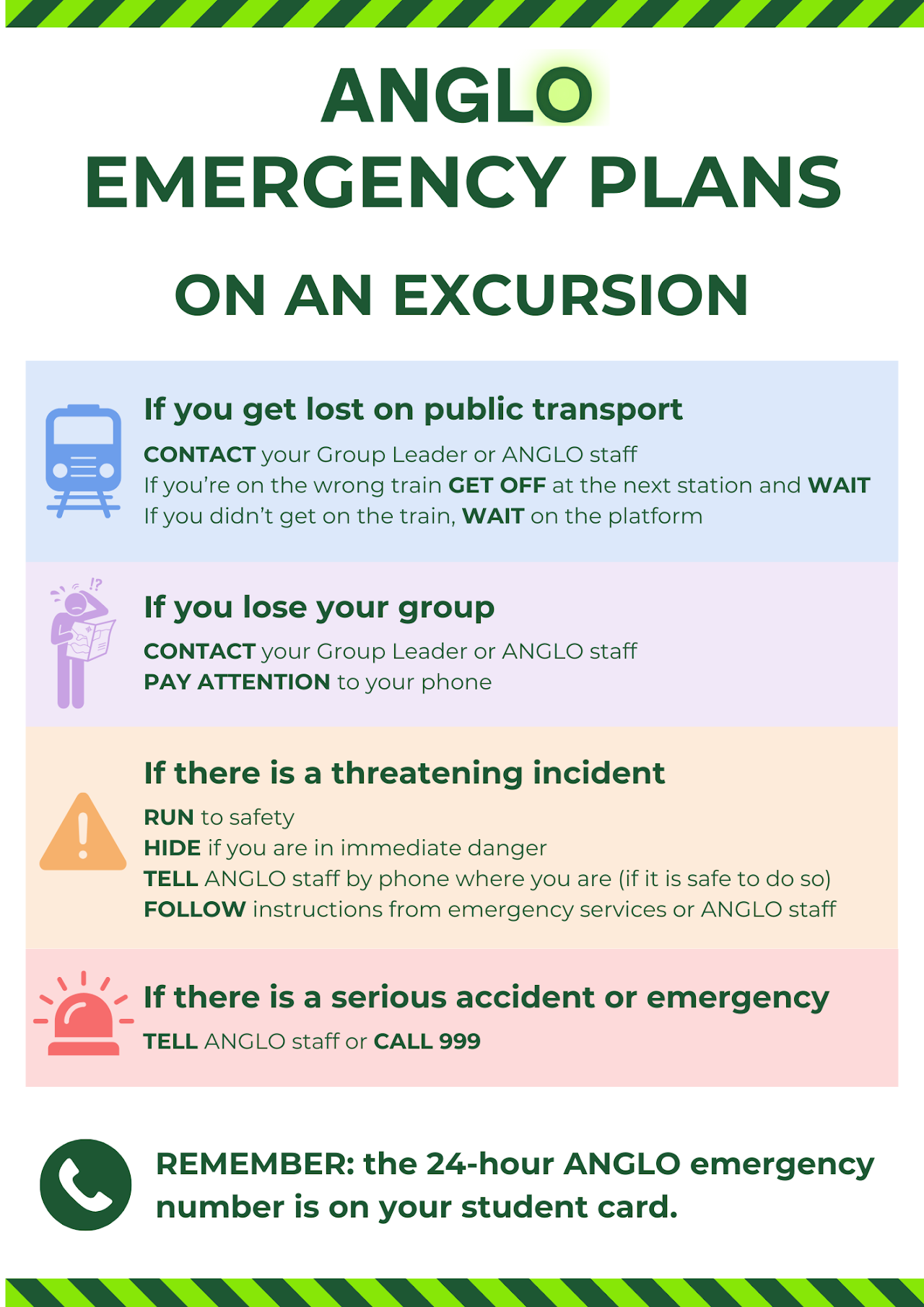](https://docs.anglo.uk.com/uploads/images/gallery/2025-12/thBn9ezYCZa1r8ig-anglo-emergency-plans.png)[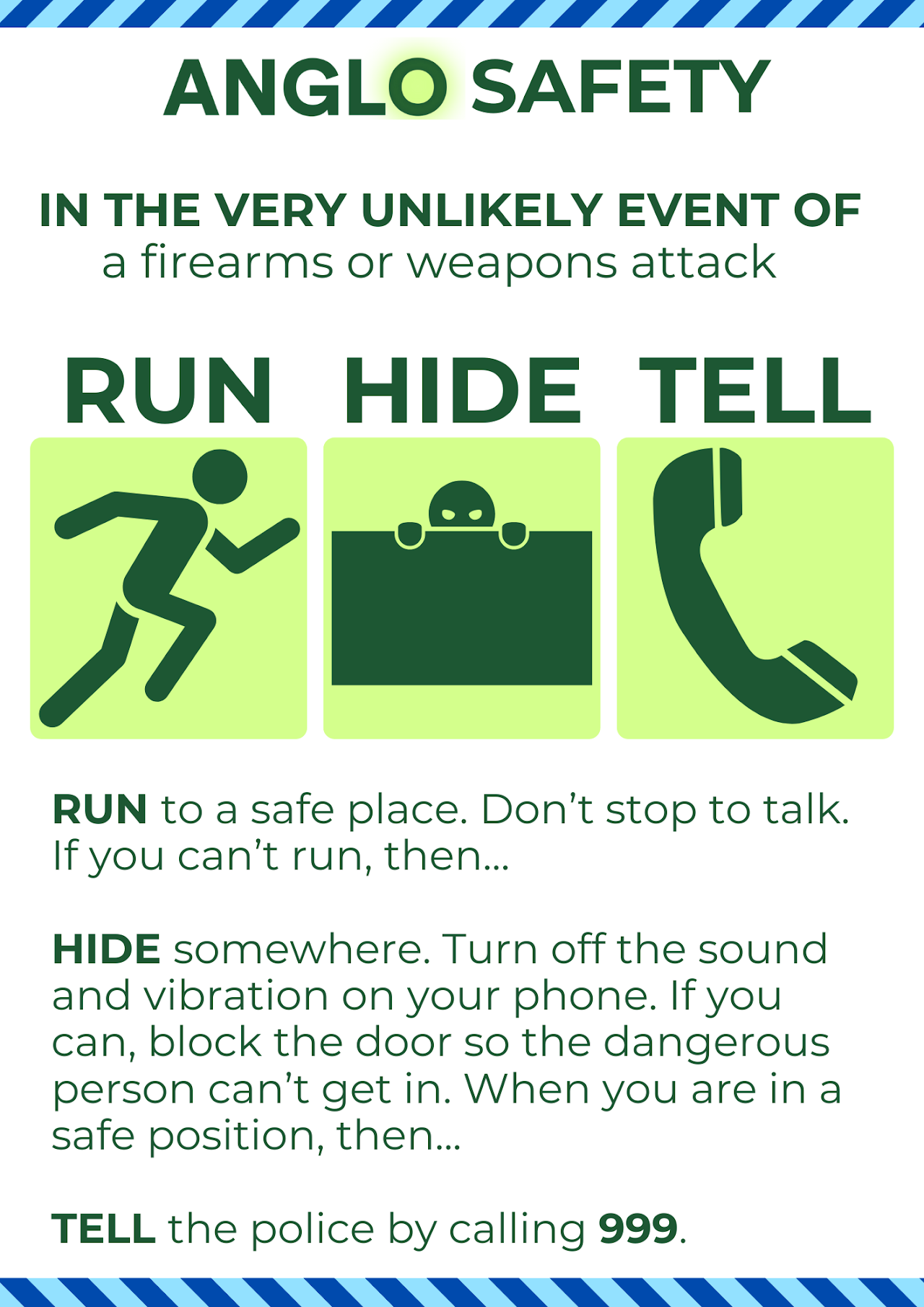](https://docs.anglo.uk.com/uploads/images/gallery/2025-12/jhkFwkkwJS06VRRD-anglo-safety.png) # Absent / Missing Students #### What to do if a student is absent or is reported missing Refer to the [Absent / Missing Student Policy](https://drive.google.com/file/d/1ZcYGS_W17tD-GZwQWdJcq1UWwqPmIv5h/view) document (available on the Staff Hub and on the wall in the Course Office and Teaching Office)Remember that all students have their lanyard and their student card with them, enabling them or those helping them to contact ANGLO staff
# Health & Safety Ensuring that equipment is safe to use, our working and learning environments are safe, and that any hazards are reported, assessed and dealt with, all form part of Health & Safety. ANGLO requires all staff to approach health and safety in a systematic way by identifying potential hazards and problems, planning improvements, taking executive action and monitoring results so that the majority of health and safety needs can be met from locally held budgets as part of day-to-day management. Many health and safety problems can, however, be rectified at little or no additional cost. Guides and policies are found on the [Resources](https://docs.anglo.uk.com/books/resources/page/resources "Resources") page and hard copies are displayed in the Course & Teaching offices at centre. Staff should be fully prepared for any emergency and this means not just knowing what to do in the event of fire, accident, or illness but also how to prevent unwanted contact from people living off-campus. #### Who to talk to about Health & Safety At centre, the SWO (or AM) will take note of any Health & Safety questions you may have. There are also Health & Safety Law posters on display in the Course Office and Teaching Office, and a digital copy is on the [Staff Hub](https://staff.anglo.uk.com/safety/hs). # Accidents & Incidents There are many precautions in place to keep everyone safe, but incidents occur that need to be dealt with by more than the people directly involved. ANGLO has a duty of care towards its staff, students and group leaders and trained staff are available 24/7 to assist. If you witness or are informed of an 'incident' (incident = an unexpected event in which a member of staff, a student or group leader was involved and where harm or danger occurred or could have occurred) you are duty bound to report it. Usually, your line manager is the first port of call. Report the incident to them. Equally, you may approach the Designated Safeguarding Person (DSP) at your centre; this is the Safeguarding & Welfare Officer or the Activity Manager. They can assist you. Your line manager or DSP may advise you to complete an [Incident Report](https://docs.anglo.uk.com#bkmrk-filing-an-incident-r). #### Filing an Incident Report Filing an incident report is easy. Go to the [Staff Hub > Safeguarding > Report Incident](https://staff.anglo.uk.com/safeguarding/incident-report) page and complete the form. If you have any issues, there are emergency contact details at the top of the form (though please make every effort to use the form). #### Reporting a Safeguarding Concern The first port of call regarding a safeguarding concern is the DSP at centre. However, the senior Designated Safeguarding Lead (DSL) is available 24/7. There is a poster with this person's name and details in the Course and Teaching Office, on the [Staff Hub](https://staff.anglo.uk.com/safeguarding), and all students have this information on their student cards. # Risk Assessments ANGLO carries out Risk Assessments for centre operations, separated into the following areas: - Campus - Activity - Excursion - Academic For each area there are many Part A risk assessments (one for each type of session that takes place at an ANGLO centre). Part A risk assessments are added, updated and reviewed before students arrive. On a daily basis there is a single Part B 'Risk Log' document. This is a 'live' document which serves to record and communicate risks to staff, students and group leaders. A more detailed and practical article on [Risk Assessments is here](https://docs.anglo.uk.com/books/key-documents/page/risk-assessments "Risk Assessments").